

Click any AI tool above to instantly get a summary of this article. Perfect for quick insights when you're short on time.
Visual content marketing helps businesses communicate ideas through images, videos, graphics, and interactive experiences that capture attention and improve understanding. In a digital environment where people quickly scan information, visual storytelling gives brands a stronger way to explain products, share knowledge, and build trust with audiences.
Modern customers expect content that is easy to consume and valuable at the same time. A strong visual marketing strategy combines creativity, audience research, branding, and measurable goals to create content that supports business growth. This article explains how visual content marketing works, why it matters, the different formats you can use, and how to create a strategy that delivers better results.
What Is Visual Content Marketing And Why Does It Matter?
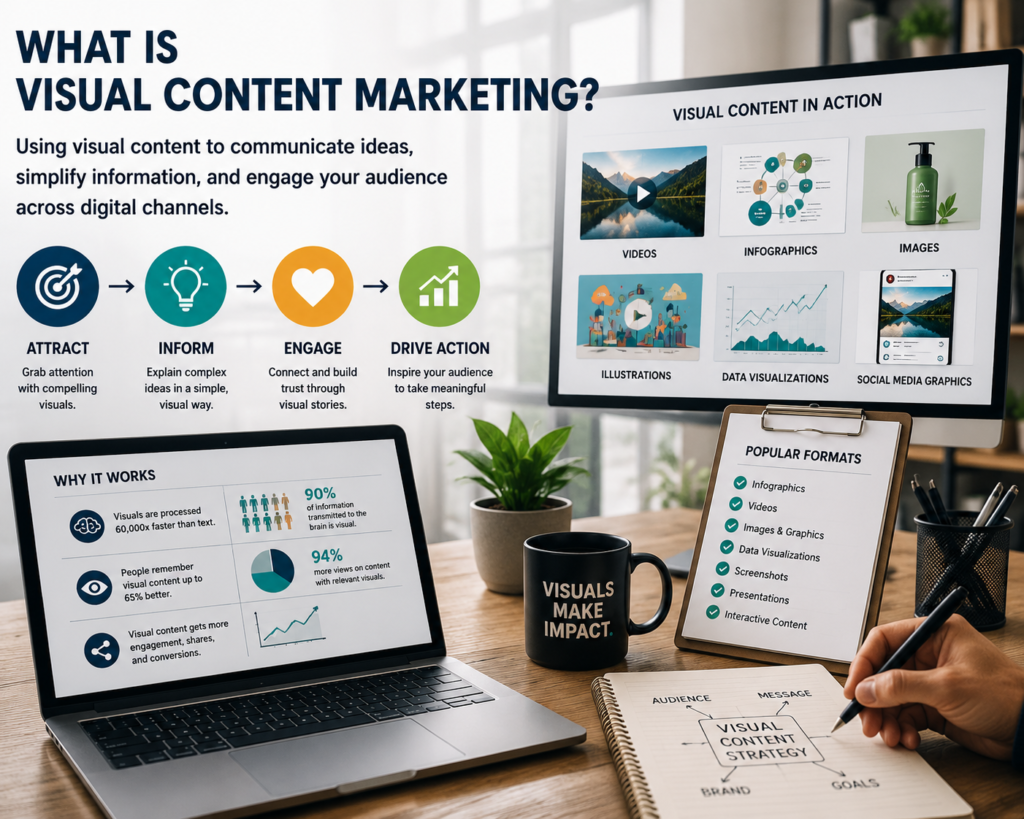
Visual content marketing is the process of creating and distributing visual materials to attract, educate, and influence an audience. Instead of relying only on written messages, businesses use visuals to simplify information, strengthen brand identity, and guide customers toward specific actions.
People process visual information quickly, which makes visual communication effective for crowded digital spaces. According to research published by the Visual Teaching Alliance, approximately 90% of information transmitted to the brain is visual. This explains why customers often remember strong images, videos, and graphics better than large blocks of text.
Visual content marketing includes many formats, such as:
- Infographics that explain complex topics
- Videos that demonstrate products or tell stories
- Social media graphics that increase engagement
- Data visualizations that present research clearly
- Screenshots that explain software features
- Presentations that organize educational information
The purpose of visual marketing is not simply to make content attractive. Effective visuals solve communication problems by helping audiences understand information faster.
Businesses can also use specialized tools to simplify the creation process. For example, companies that need professional infographic designs can use platforms that help them generate stunning infographics from simple ideas without starting every project from scratch. These solutions help marketers transform concepts into structured visual content while maintaining consistency.
Must-know Tip: Successful visual content begins with a clear message. Before designing anything, define what your audience should understand, remember, or do after seeing the visual.
Visual content marketing matters because attention has become one of the most valuable resources online. Brands that communicate clearly through visuals have a stronger chance of building awareness, increasing engagement, and creating lasting customer relationships.
How Visual Content Marketing Supports Brand Growth And Customer Engagement

Visual content marketing supports brand growth because it helps businesses communicate their value in a way that feels more immediate and memorable. Customers often make decisions based on how clearly they understand a product, service, or idea, and visuals reduce the effort required to process information.
A strong visual strategy improves several areas of digital marketing, including social media performance, website engagement, email campaigns, and customer education. Platforms such as Instagram, TikTok, YouTube, and LinkedIn have increased the importance of visual communication because audiences expect content that delivers value quickly.
Recent digital marketing trends show that video continues to dominate online engagement. According to HubSpot’s 2025 State of Marketing report, short-form video remains one of the highest-performing content formats used by marketers. Businesses are investing more in visual storytelling because audiences respond well to demonstrations, tutorials, behind-the-scenes content, and educational videos.
Visual content also strengthens brand recognition. When companies consistently use similar colors, design styles, and messaging patterns, customers can identify their content more easily.
Important benefits include:
- Stronger audience attention
- Better information retention
- Increased social sharing
- Improved customer trust
- Higher content engagement
- More opportunities for brand differentiation
Visual marketing also helps businesses explain complicated products. A software company, for example, can use screenshots and product videos to demonstrate functionality more effectively than a long written explanation.
Must-know Tip: The best-performing visuals focus on customer needs first. A design should answer a question, solve a problem, or provide useful information instead of only promoting a brand.
Businesses that treat visuals as part of their communication strategy create more meaningful connections. The goal is not to produce more images but to create visual experiences that help customers understand and trust the brand.
Types Of Visual Content You Can Use In A Marketing Strategy
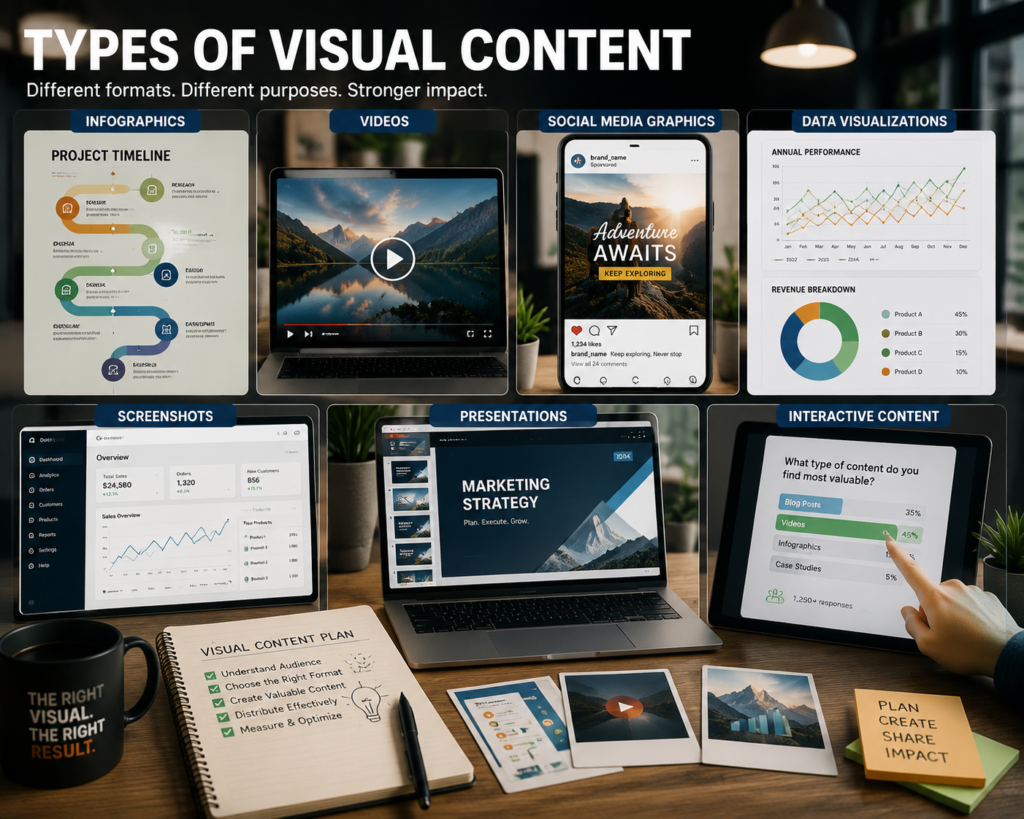
Businesses have many visual content options, and each format serves a different purpose. Choosing the right type depends on your audience, marketing objective, and the message you want to communicate.
Infographics remain one of the most effective formats for explaining statistics, processes, and comparisons. They combine text, icons, illustrations, and data to make complicated subjects easier to understand.
Videos are another powerful format because they combine movement, sound, and storytelling. Companies use videos for product demonstrations, customer testimonials, educational tutorials, and brand storytelling.
Other common visual formats include:
Images And Social Media Graphics
Images help brands create quick connections with audiences. Social graphics can promote campaigns, share tips, highlight products, and increase engagement across platforms.
Data Visualizations
Data visualization transforms numbers into understandable visuals. Charts, graphs, and diagrams help audiences identify patterns without analyzing large amounts of raw information.
Interactive Content
Interactive visuals allow users to participate rather than passively consume information. Examples include quizzes, calculators, interactive reports, and digital experiences.
Presentations And Documents
Professional presentations help businesses share research, strategies, and educational materials in a structured format.
The effectiveness of each format depends on proper planning. A customer looking for a product tutorial needs different content than someone researching industry trends.
Must-know Tip: Match the visual format with the customer journey stage. Educational visuals work well for awareness, while demonstrations and case studies support purchasing decisions.
Visual content performs best when it supports a specific marketing goal. Instead of creating visuals randomly, businesses should choose formats that communicate their message clearly and provide value to their audience.
How To Create An Effective Visual Content Marketing Strategy

Creating effective visual content requires more than choosing attractive designs. A successful strategy starts with understanding your audience, defining objectives, and creating visuals that support measurable outcomes.
The first step is identifying your target audience. You need to understand their challenges, interests, preferences, and the type of information they find useful.
A strong visual content strategy includes:
- Clear marketing goals
- Audience research
- Brand guidelines
- Content planning
- Distribution channels
- Performance tracking
Your goals determine the type of visuals you create. If your goal is brand awareness, engaging social media graphics and videos may work best. If your goal is education, infographics and tutorials may provide better results.
Consistency is another important factor. Brands should maintain recognizable design elements, including typography, colors, imagery style, and messaging tone.
Artificial intelligence has also changed visual content creation. Recent AI adoption trends show that marketers increasingly use AI tools to speed up design processes, generate ideas, and improve content production efficiency. However, human creativity and strategic thinking remain essential for creating visuals that connect emotionally.
Must-know Tip: Use technology to improve your workflow, but always review visuals from the customer’s perspective. A technically impressive design still fails if the message is unclear.
A complete visual marketing strategy also requires testing. Track performance indicators such as engagement rate, click-through rate, conversions, shares, and audience feedback.
When businesses combine creativity with measurement, visual content becomes a reliable marketing asset instead of a one-time campaign activity.
Common Visual Content Marketing Mistakes To Avoid
Many businesses invest in visual content but fail to achieve results because they focus on appearance instead of communication. Attractive design alone does not guarantee successful marketing.
One common mistake is creating visuals without a clear purpose. Every image, video, or graphic should support a specific objective. If audiences cannot understand the message quickly, the visual loses effectiveness.
Another mistake is ignoring accessibility. Businesses should consider:
- Readable text sizes
- Strong color contrast
- Descriptive image information
- Mobile-friendly designs
Mobile optimization is especially important because most digital content consumption happens through smartphones. A design that looks excellent on a desktop may become difficult to understand on a smaller screen.
Businesses also make mistakes by creating content without measuring results. Tracking performance helps identify which formats attract attention and which require improvement.
Must-know Tip: A successful visual marketing campaign combines creativity, usability, and analytics. Strong visuals look good, communicate clearly, and produce measurable results.
Avoiding these mistakes helps brands create content that supports long-term growth. The best visual marketing strategies focus on customer experience rather than short-term attention.
How To Measure The Success Of Visual Content Marketing
Measuring visual content performance helps businesses understand whether their investment creates meaningful results. Without measurement, companies cannot identify successful formats or improve future campaigns.
Important metrics include:
- Engagement rate
- Website traffic
- Conversion rate
- Social shares
- Click-through rate
- Time spent on pages
- Lead generation
Different goals require different measurements. A brand awareness campaign may focus on impressions and shares, while a product campaign may prioritize conversions and sales.
Analytics tools provide valuable insights into audience behavior. Marketers can identify which visuals attract attention, which platforms perform best, and which messages create stronger responses.
According to Wyzowl’s 2025 Video Marketing Statistics report, video continues to be a major marketing investment, with most businesses using video as part of their communication strategy. This trend shows that companies increasingly rely on measurable visual formats to reach audiences.
Businesses should also test different approaches. Changing headlines, colors, layouts, or formats can reveal what works best for specific audiences.
Must-know Tip: Do not judge visual success only by likes. A visual that generates qualified leads or improves customer understanding creates more business value than one that receives temporary attention.
Measurement turns visual marketing from guesswork into a strategic process. By analyzing results, businesses can improve content quality and create stronger connections with their audiences.
The Future Of Visual Content Marketing
Visual content marketing will continue evolving as technology changes how people create and consume information. Artificial intelligence, interactive experiences, personalized content, and short-form video are shaping the next generation of digital communication.
AI-powered tools are making visual production faster by helping marketers generate concepts, improve designs, and create content variations. However, successful brands will continue to depend on human creativity, storytelling, and audience understanding.
Personalization will also become more important. Customers increasingly expect content that matches their interests and needs. Businesses that use customer data responsibly can create more relevant visual experiences.
Another important trend is interactive content. Instead of simply watching or viewing content, audiences increasingly want opportunities to participate.
Future visual marketing strategies will focus on:
- Personalized experiences
- AI-assisted creativity
- Interactive storytelling
- Accessible design
- Data-driven optimization
Must-know Tip: The future of visual marketing belongs to brands that combine technology with authentic storytelling. Tools can improve production, but meaningful messages create lasting connections.
Companies that adapt to these changes will have stronger opportunities to attract attention and build relationships in competitive digital environments.
Conclusion
Visual content marketing gives businesses a practical way to communicate ideas, attract audiences, and build stronger relationships in a crowded digital environment. By combining storytelling, strategic planning, and creative design, brands can create visuals that educate customers and encourage meaningful actions.
Successful visual marketing does not depend only on producing attractive graphics. It requires understanding your audience, choosing the right formats, maintaining consistency, and measuring performance. Companies that approach visuals strategically can improve engagement, strengthen brand recognition, and create better customer experiences.
As technology continues to develop, visual content will become even more important. Businesses that invest in useful, accessible, and memorable visuals will have a stronger advantage when competing for audience attention.
Frequently Asked Questions About Visual Content Marketing
What Is Visual Content Marketing?
Visual content marketing is the use of images, videos, graphics, and interactive content to communicate marketing messages and engage audiences.
Why Is Visual Content Important In Marketing?
Visual content helps audiences understand information faster, improves engagement, and makes brand messages easier to remember.
What Are Examples Of Visual Content?
Examples include videos, infographics, social media graphics, screenshots, presentations, illustrations, and data visualizations.
How Does Visual Content Improve SEO?
Visual content can improve SEO by increasing engagement, supporting user experience, attracting backlinks, and helping search engines understand page content through optimization.
Is Video The Most Effective Type Of Visual Content?
Video is one of the strongest visual formats because it combines storytelling, movement, and sound, but effectiveness depends on the marketing goal.
How Often Should Businesses Create Visual Content?
Businesses should create visual content consistently based on their goals, resources, and audience needs rather than focusing only on quantity.
Can Small Businesses Use Visual Content Marketing?
Yes. Small businesses can use affordable design tools, social media visuals, and simple videos to compete with larger brands.
How Does AI Affect Visual Content Marketing?
AI helps marketers generate ideas, automate design tasks, and improve production speed while human strategy remains necessary.
What Makes A Visual Marketing Strategy Successful?
A successful strategy combines audience research, clear goals, quality design, consistent branding, and performance measurement.
How Do You Measure Visual Content Success?
You can measure success through engagement, traffic, conversions, shares, leads, and other business-focused metrics.

Comments
0 responsesNo comments yet. Be the first to share your thoughts.